
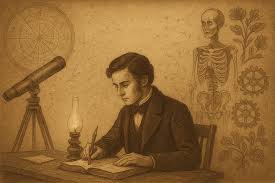
The Victorian era (1837–1901) was a period of intense interaction between science and literature. Scientific discoveries in geology, astronomy, and biology not only changed society’s worldview but also deeply influenced the vocabulary and imagery of poetry. Studying this interaction helps us understand how literature reflects the scientific achievements of its time and how poetic language adapts to new knowledge about the world.
The Influence of Geology on Poetic Language
One of the key scientific achievements of the 19th century was geology, which allowed humanity to understand the Earth’s age and the processes shaping its surface. The works of Charles Lyell, particularly Principles of Geology (1830–1833), introduced the concept of gradual changes and a deep temporal scale for the planet. This perspective had a strong impact on poetic language.
Victorian poets began to use geological terms not only to describe nature but also to convey philosophical and emotional meanings. Words such as “strata,” “deposits,” “rocks,” and “fossils” became metaphors for time, memory, human life, and historical continuity. For example, the geological principle of gradual change inspired poets to create images of slow but inevitable transformations, reflecting inner emotional processes.
The influence of geology also appeared in form: poets began using long, gradually unfolding stanzas to convey the sense of time on a planetary scale. Thus, new expressive means related to scientific understanding of the world emerged in poetic language, enhancing the intellectual and philosophical depth of the works.
 Astronomy and the Expansion of Cosmic Horizons
19th-century astronomy experienced rapid development. The discovery of new planets, comets, and the study of the starry sky allowed humans to see the Earth as a small part of a vast universe. Victorian poets perceived this as a challenge to traditional notions of humanity and nature, which found expression in their work.
Poems of the time began to include astronomical vocabulary: “celestial spheres,” “star systems,” “comets,” “cosmic paths.” This terminology allowed the creation of large-scale, cosmic metaphors, expressing the human sense of smallness before infinity and simultaneously their ability to observe and comprehend it. Poetry thus became a medium for philosophical reflection on humanity’s place in the universe.
Moreover, astronomical concepts allowed poets to explore ideas of time and eternity. For instance, planetary cycles, presented as regular and recurring patterns, were used to create musicality in poems, synchronized with the rhythm of the cosmos. This demonstrates how scientific language not only expanded the poetry’s vocabulary but also shaped new aesthetic principles.
Evolution and Biological Metaphors
One of the most revolutionary discoveries of the 19th century was Charles Darwin’s theory of evolution, presented in On the Origin of Species (1859). It changed ideas about the origin of life, humanity’s place in nature, and the meaning of existence. In poetry, this led to new metaphors related to variability, adaptation, and survival.
Victorian poetry began to include biological terms and imagery: “struggle for existence,” “natural selection,” “species,” “transformation.” These concepts were used not only to scientifically describe nature but also as symbols of moral and spiritual processes: the transformation of the human soul, moral choices, and cultural development.
Poets created imaginative worlds where natural laws and biological processes served as the basis for philosophical reflection. For example, the struggle for life could symbolize a person’s inner conflict with fears or their pursuit of self-improvement. Biological terminology thus enriched the emotional and conceptual range of poetry, making it simultaneously scientific and artistic.
Scientific Language as a Tool for Metaphor
The interaction of science and poetry was not limited to simple borrowing of terms. Scientific language became a tool for creating complex metaphors and symbolic systems. Geological, astronomical, and biological terms were used to express abstract ideas such as time, change, eternity, cycles, survival, and moral choice.
For example, fossils in poetry could symbolize memory and traces of past generations, while planetary motion could signify the rhythm of life and the inevitability of events. Concepts of evolution allowed poets to explore ideas of progress, transformation, and even humanity’s moral responsibility toward future generations. Scientific language thus became both descriptive and philosophical, expanding the possibilities of poetic expression.
Social and Cultural Context of Science’s Influence
Scientific discoveries in the Victorian era occurred against the backdrop of profound social and cultural changes. Industrialization, urban growth, new technologies, and expanding education created an audience capable of engaging with scientific ideas. Poets responded to these changes by integrating scientific concepts into their works.
The use of scientific language in poetry also reflected literature’s aspiration toward intellectual rigor. Poets sought to demonstrate to readers that they were informed about contemporary scientific knowledge and could merge emotion with rational concepts. This enhanced the poet’s authority and made poetry a medium of cultural dialogue between science and society.
Moreover, scientific metaphors allowed poets to address social and moral questions: progress and society’s moral development, humanity’s role in nature, and responsibility for future generations. Thus, scientific language served not only an artistic function but also a socio-cultural one.
Examples of Specific Poets and Works
This connection between science and poetry is vividly illustrated in the works of poets such as Alfred Tennyson, Robert Browning, and Gerard Manley Hopkins.
-
Alfred Tennyson actively used cosmic and temporal imagery, creating vast universal metaphors that reflected 19th-century astronomical discoveries. His poems frequently feature planetary cycles, celestial bodies, and eternity.
-
Robert Browning applied evolutionary ideas and biological metaphors to create psychologically complex images and moral dilemmas, highlighting the dynamics of the human soul.
-
Gerard Manley Hopkins integrated geological and natural terms into his poetry, creating powerful images of strata, change, and the forces of nature, often combined with religious and spiritual reflection.
These examples show that scientific language not only enriched vocabulary but also enhanced philosophical depth, making Victorian poetry intellectually dense and multifaceted.
Aesthetic Consequences of Scientific Vocabulary
Scientific terms in poetry not only expanded the lexicon but also influenced style and rhythm. Using precise terminology required poets to pay attention to sound organization and word harmony. Many poets adapted stanzaic structures, creating long, complex rhythmic patterns that mirrored natural order and processes.
Thus, scientific language altered not only the content of poetry but also its form, encouraging new aesthetic techniques and experimental methods. Poets sought to combine the precision of scientific terminology with emotional expressiveness, creating a unique blend of rational and sensory experience.
Influence on the Reader and Cultural Perception
For Victorian readers, poetry with scientific elements opened new horizons for understanding the world. Scientific vocabulary allowed a poem to be perceived not only as an emotional experience but also as an intellectual investigation. This fostered a culture in which knowledge and aesthetic experience mutually reinforced each other.
Furthermore, integrating science into poetry reflected changes in human self-perception: awareness of humanity’s role in the universe, responsibility toward nature and society, and understanding of historical and biological processes. Scientific language became a bridge between rational and emotional realms, enriching the cultural experience of society.
Limitations and Criticism
Despite clear advantages, the use of scientific language in poetry was not without problems. Some Victorian critics believed that excessive reliance on terminology could make a poem dry and emotionally detached. It was also not always easy to harmoniously combine scientific precision with musicality and metaphorical richness.
Nevertheless, most poets successfully overcame these limitations, using scientific terms as tools for creating complex imagery and philosophical reflection. This experience demonstrated that poetry could be simultaneously emotional, artistic, and scientifically informed.
Key Takeaways
-
Geological terms were used as metaphors for time, memory, and transformation.
-
Astronomical vocabulary enabled the creation of cosmic imagery and philosophical reflections on humanity’s place.
-
Biological and evolutionary terms reflected ideas of change, progress, and inner human struggle.
-
Scientific language became a tool for metaphor, combining the rational and the emotional.
-
Integrating science into poetry strengthened the poet’s intellectual authority and cultural dialogue.
-
Precise terminology influenced the form and rhythm of poems.
-
Scientific language expanded the aesthetic possibilities and philosophical depth of poetry.
-
Victorian poetry demonstrates a harmony of science and art, emotion and reason.
Conclusion
The Victorian era demonstrates a unique symbiosis of science and poetry. Geology, astronomy, and evolutionary biology not only expanded poets’ vocabulary but also created new opportunities for philosophical and aesthetic exploration of the world. Scientific language became a tool for metaphor, a means of philosophical reflection, and a vehicle for cultural dialogue. As a result, 19th-century poetry gained a distinctive intellectual depth, reflecting the complexity and richness of the scientific knowledge of its time.