
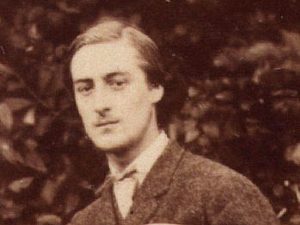
Gerard Manley Hopkins (1844–1889) was a Victorian English poet renowned for his experiments with language and rhythm. His unique contribution to literature lies in the creation of “sprung rhythm,” a new system of intonation, and unusual sound-based poetic techniques. Hopkins viewed poetic language not only as a vehicle for conveying meaning but also as a physical object, where sound, rhythm, and intonation shape the emotional and philosophical perception of the text. Studying his work allows us to understand how poetry can experiment with language and rhythm to create a sense of movement, vibration, and emotional intensity.
 Biographical and Cultural Context
Hopkins was born in London into a devout Catholic family, which profoundly influenced his poetry. He became a priest in the Jesuit order, which shaped the themes of his poems: natural beauty, spiritual experience, and the search for the divine. The Victorian era was marked by industrialization, scientific progress, and social transformation. Hopkins responded to these changes through language and form, seeking harmony between inner experience, nature, and the modern world.
At the time, English poetry was strictly metrically organized, dominated by iambic tetrameter, pentameter, and rhymed stanzas. Hopkins rejected these conventions, believing that traditional meter could not convey the intensity of emotion or the dynamic flow of nature. This desire for innovation became the foundation of his “sprung rhythm” and experiments with intonation.
Sprung Rhythm
Sprung rhythm is Hopkins’s central contribution to poetics. Unlike traditional metric rhythm, where stresses and syllable counts are fixed, sprung rhythm is based on the number of stressed syllables, while unstressed syllables can vary. This creates a sense of movement, spontaneity, and natural speech while preserving musicality.
Hopkins wrote that the goal of poetry is to convey life’s breath and pulse rather than follow outdated patterns. In his verse, language functions as a physical object: words and syllables “vibrate,” creating rhythmic energy. Sprung rhythm allows for the expression of emotional tension, inner soul rhythms, and the beauty of nature without the constraints of traditional meter.
A prime example is the poem The Windhover, where rhythm reflects the bird’s flight. Stressed syllables mark moments of tension and ascent, while unstressed syllables form the spaces that allow the reader to experience movement. Sprung rhythm here is not merely a technical device but a means of embodying physical motion and emotional resonance.
Intonation and Sound Patterns
For Hopkins, sound and intonation were inseparable from meaning. He employed alliteration, assonance, consonance, and internal rhyme to enhance emotional impact. For example, sequences of the consonants “s,” “sh,” and “f” can evoke the whisper of wind or the flow of water. Hopkins often placed rhymes within lines, creating a “sound framework” that reinforces presence and immersion.
Intonation also interacts with breath. Sprung rhythm demands careful reading: stressed syllables act as anchors, while unstressed syllables provide spaces for movement. Hopkins’s poetry integrates meaning, sound, and physical perception, producing a synthesis of emotion, motion, and philosophical reflection.
Experimentation and Innovation
Hopkins consciously experimented with language, creating neologisms, archaisms, and unusual syntactic structures. He drew on Old English forms and Latin elements to convey the depth of feeling and philosophical ideas. His experimentation was a tool for exploring the “inner physics of language.”
He considered the poem as a living organism. Each word, stressed or unstressed syllable, is a component of a dynamic system where rhythm and sound generate emotional energy. Hopkins spoke of the “intensity” of words, emphasizing that language should carry not only meaning but emotional and physical force.
Reader Engagement
Hopkins’s poetry demands active participation. Sprung rhythm and intricate sound patterns create an “irregular wave” that must be felt. The reader becomes a co-creator: catching the line’s breath, experiencing stressed and unstressed syllables, and sensing the motion of intonation. This active involvement heightens emotional and philosophical impact: language functions as energy, vibration, and musical flow, conveying life, inner experience, and the divine.
Examples of Poems
The Windhover
The bird hovering in the air serves as a metaphor for divine inspiration. Sprung rhythm mirrors its movements: long syllables simulate soaring, short syllables depict abrupt shifts in direction. Sound effects intensify the sense of flight, creating emotional tension and awe.
Pied Beauty
This poem celebrates the diversity of nature. Alliteration and assonance highlight contrasts and harmony in colors and forms. Sprung rhythm “binds” the enumerations, creating a sense of movement and variability that reflects the theme of transitory beauty and multiplicity.
God’s Grandeur
Dedicated to divine presence in the world, the poem uses intonation, internal rhymes, and repetition to create vibrancy that conveys spiritual experience. Rhythm accentuates the contrast between worldly turmoil and the eternal power of the divine, making the poetic language physically tangible and philosophically significant.
Hopkins and the Physics of Language
The term “physics of language” reflects Hopkins’s approach: words and rhythm possess energy and dynamics. Language is not merely a tool for conveying information; it is a physical entity, studied in terms of vibration, rhythm, intonation, and emotional charge. His poetry demonstrates how words can become material, musical, and energetic phenomena.
Influence on Modern Poetry
Hopkins influenced many 20th- and 21st-century poets. His experiments with rhythm, intonation, and sound inspired modernists and postmodernists. Sprung rhythm foreshadowed free verse, while his sound techniques demonstrated how language can function simultaneously as musical and physical instrument.
Contemporary scholars see in Hopkins a synthesis of aesthetics, philosophy, and the physics of language. His poetry illustrates that a poem is not only a text but a sound, rhythm, and physical system affecting the reader on multiple levels.
Key Features of Hopkins’s Poetry
-
Sprung rhythm — a flexible system of stressed and unstressed syllables creating movement and dynamic flow.
-
Intonation and sound patterns — alliteration, assonance, and internal rhyme enhance emotional impact.
-
Experimental language — neologisms, archaisms, and unusual syntactic structures.
-
Physics of language — words and rhythm function as material and energetic elements.
-
Reader engagement — active, emotional, and physical experience of the poem.
-
Philosophical depth — connection between nature, inner life, and the divine through language and rhythm.
-
Impact on modern poetry — precursor to free verse and experimental sound techniques.
Conclusion
Gerard Manley Hopkins created a unique synthesis of form, intonation, and philosophy. His sprung rhythm and experiments with sound structure produce movement, vibration, and emotional intensity. Language becomes a physical, musical, and energetic object, while reading becomes an active experience. Hopkins’s poetry remains relevant today, demonstrating the potential of language as a medium for expressing inner life, the beauty of nature, and spiritual experience.